
This is the updated paragraph with additional mentions of deck care mistakes to improve keyword density, addressing common deck care mistakes that can lead to costly repairs.
The good news? Every one of these deck care mistakes is avoidable once you know what to look for. This guide covers the five most common errors we see across Kansas City backyards, and exactly how to fix each one before it costs you thousands in repairs.
Understanding the most common deck care mistakes helps homeowners avoid costly repairs. These deck care mistakes can lead to significant structural issues if not addressed promptly.
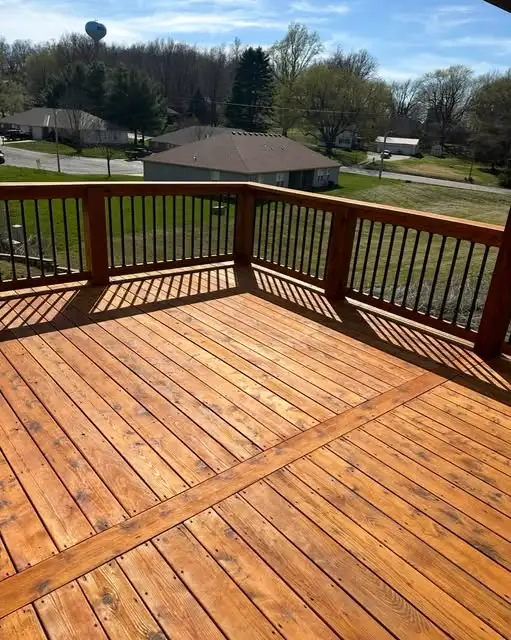
Mistake #1: Skipping Annual Deck Inspections, The Most Common Deck Care Mistake
In Kansas City, many homeowners make deck care mistakes that could easily be avoided with regular maintenance and inspections. Recognizing these deck care mistakes is crucial to extending the life of your deck.
This is the deck care mistake that enables every other problem on this list. Most homeowners walk on their deck daily but never actually inspect it. They don’t flip boards to check underneath. They don’t test railing connections. They don’t look at the ledger board where the deck meets the house.
One of the biggest deck care mistakes is neglecting to inspect your deck regularly for wear and tear. Failing to do so can lead to serious problems that result from common deck care mistakes.
Here’s why that matters: an estimated 20 million of the 40 million decks in the United States aren’t built to current building codes, according to the North American Deck and Railing Association (NADRA). Roughly half of all existing decks have structural issues that a simple annual inspection would catch early, before a board gives way during a family barbecue.
By learning about deck care mistakes, you’re taking a proactive approach to maintaining your deck and ensuring its longevity.
What to Inspect (and When)
Do a full inspection every spring before deck season starts. Here’s the checklist our team at KC Deck Services uses:
Many homeowners unknowingly contribute to deck care mistakes that can compromise the integrity of their outdoor space.
- Ledger board connection, Check where the deck attaches to your house. Look for gaps, rust on bolts, or soft wood. This is the #1 failure point in deck collapses.
- Post bases, Push on each support post. Any movement means the footing or post base needs attention immediately.
- Joist condition, Look underneath the deck. Joists that are cracked, sagging, or showing dark discoloration indicate rot.
- Railing stability, Grab each railing section and push firmly. Building code requires railings to withstand 200 pounds of lateral force. If yours wobble, they won’t.
- Fastener condition, Look for popped nails, corroded screws, or loose hardware. Kansas City’s freeze-thaw cycles work fasteners loose over time.
- Surface boards, Walk every square foot. Feel for soft spots, check for cracks wider than 1/8 inch, and note any boards that flex under your weight.
A thorough inspection takes 30 minutes. Skipping it can cost $750 to $2,500 in repairs when small problems become big ones, per Angi’s 2026 repair cost data.
Regular inspections can catch deck care mistakes early, preventing them from escalating into major issues that require costly repairs.
Mistake #2: Pressure Washing at the Wrong PSI
Pressure washing your deck sounds like responsible maintenance. And it can be, if done correctly. But most homeowners grab a pressure washer from the hardware store, crank it to full power, and blast away. The result is permanent damage that actually accelerates deterioration instead of preventing it.
When the pressure is too high (above 1,500 PSI for softwoods like cedar and pressure-treated pine), the water stream tears into the wood’s soft grain. This creates what professionals call “tiger striping”, deep grooves that trap water, invite mold growth, and cannot be sanded out without removing significant material. According to wood finishing specialists, these indentations allow water to pool, freeze in winter, and crack the wood from within.
A University of Florida study also found a health hazard: decks built before 2004 with CCA-treated wood release arsenic at three times the normal rate when wet. Pressure washing these older decks can create a contaminated mist. An estimated 20 million U.S. homes still have CCA-treated decks.
It’s important to understand that pressure washing can cause deck care mistakes if not done correctly, leading to irreversible damage.
The Right Way to Clean Your Deck
- Use 500-1,200 PSI maximum for softwood decks (cedar, pine, pressure-treated)
- Use a fan tip (25° or 40°), never a zero-degree tip
- Keep the nozzle 12-18 inches from the surface and move with the grain, not against it
- Use a deck-specific cleaning solution rather than relying on water pressure alone
- For composite decks, follow manufacturer guidelines, most recommend 1,300 PSI max with a fan tip
If your deck is older than 2004 or you’re unsure of the wood type, consider hiring a professional. At KC Deck Services, our power washing and sealing service uses calibrated equipment that cleans thoroughly without damaging the wood.
Mistake #3: Waiting Too Long to Stain or Seal
Addressing the common deck care mistakes in a timely manner is essential for maintaining the beauty and function of your deck.
This deck care mistake costs Kansas City homeowners more money than any other. Wood decks need staining or sealing every two to three years, period. Cedar decks need it annually. Yet a 2026 Today’s Homeowner survey found that nearly 60% of U.S. homeowners are putting off home repairs due to cost, and deck maintenance is often first on the deferral list.
Here’s what happens when you delay: Kansas City gets approximately 38.8 inches of rain per year plus 12.5 inches of snow. Without a protective seal coat, that moisture penetrates the wood grain during every storm. When temperatures drop below freezing, which happens roughly 151 days per year in KC, that trapped moisture expands as ice, splitting the wood fibers from the inside out.
One season of exposure without sealant can reduce your deck’s total lifespan by two to three years. Two seasons and you’re looking at board replacement rather than a simple re-coat. The math is straightforward: a refurbishing (cleaning + staining) costs $500 to $1,600 versus $750 to $2,500 or more for repairs once the damage sets in.
How to Time Your Stain or Seal Coat
-
- The water test: Sprinkle water on your deck surface. If it beads up, your sealant is still working. If it soaks in immediately, you’re overdue.
- Best timing in Kansas City: Late April through early June, or September through mid-October. You need 48+ hours of dry weather above 50°F after application.
- New decks: Wait 3-6 months after construction before the first stain or seal. The wood needs to dry and open its pores to absorb the product.
- Composite decks: Don’t stain them. Composite doesn’t need staining or sealing, that’s one of its biggest advantages. A simple soap-and-water wash once or twice a year is all it needs.
Be mindful that many homeowners make deck care mistakes by delaying the staining and sealing process, which can lead to wood rot.
Mistake #4: Ignoring Drainage and Water Pooling
Water is the number one enemy of every wood deck. Not UV exposure, not foot traffic, not age, water. And the most overlooked deck care mistake is letting water sit on or under the deck without a plan for where it goes.
Deck boards should be installed with a slight gap (typically 1/8 to 3/16 inch) between them to allow water drainage and airflow. Over time, debris accumulates in those gaps, leaves, dirt, pollen, pine needles. Once the gaps are blocked, water pools on the surface, soaks into end grains, and accelerates rot.
Underneath the deck is equally important. If water pools at the base of your support posts, those posts will rot from the bottom up, often invisibly, since the damage happens underground or at the concrete footing interface. The International Residential Code (Section R507) requires specific post-to-footing connections and drainage provisions for exactly this reason.
Improper drainage and water pooling are significant deck care mistakes that can cause damage and deterioration of your deck.
How to Fix Drainage Issues
- Clean the gaps between deck boards at least twice per season, spring and fall. A putty knife or specialized deck gap cleaner tool works well.
- Check for pooling after a heavy rain. If water sits on the surface for more than an hour, your boards may be cupped (warped) and need replacement.
- Grade the ground underneath to slope away from the house and deck posts. Water should never pool under the structure.
- Add a drip edge or under-deck drainage system if you use the space below your elevated deck as a patio.
- Trim vegetation that’s within 12 inches of the deck. Plants trap moisture against wood and restrict airflow.
Mistake #5: DIY Structural Repairs Without Understanding Load Requirements
The fifth and most dangerous deck care mistake is attempting structural repairs without understanding how decks distribute weight. Swapping a surface board is a reasonable DIY task. Replacing a joist, modifying a railing, or re-attaching a ledger board is not, these are structural elements where mistakes can cause catastrophic failure.
Many homeowners unknowingly make deck care mistakes when attempting structural repairs without the proper knowledge.
The Consumer Product Safety Commission (CPSC) reports approximately 725 injuries per year from deck, porch, and balcony collapses specifically, not trips or falls, but actual structural failures. Many of these involve decks that were repaired improperly by homeowners who didn’t understand load path engineering or the building code requirements that govern it.
What Counts as Structural (Don’t DIY These)
- Ledger board attachment, This connection bears the entire house-side load of the deck. It requires specific lag bolt patterns, flashing, and often a building inspection.
- Joist replacement, Joists carry the live load (people, furniture) to the beams. Incorrect sizing, spacing, or connection hardware can create a failure point.
- Post or footing replacement, Posts transfer the deck’s entire weight to the ground. Footing depth must reach below the frost line (36 inches in Kansas City) to prevent heaving.
- Railing modification, Railings must meet specific height (36 inches for residential, 42 inches for commercial) and spacing (less than 4 inches between balusters) requirements per the IRC.
- Stair stringer replacement, Stringers carry concentrated loads and must follow code for rise, run, and attachment.
What You Can Safely DIY
Understanding what you can safely DIY helps to minimize the risks associated with common deck care mistakes.
- Replacing individual surface boards (non-structural)
- Cleaning and re-sealing
- Tightening loose screws and replacing corroded fasteners
- Cleaning debris from board gaps and under the deck
- Minor cosmetic repairs (sanding splinters, filling small cracks)
When in doubt, call a professional. At KC Deck Services, we handle both full deck builds and repair projects. A quick inspection can tell you whether your issue is a 20-minute DIY fix or a structural concern that needs expert attention. Request a free estimate and we’ll take a look.
How Much Do Deck Care Mistakes Actually Cost?
Neglecting to invest in preventive measures can lead to the most common deck care mistakes, which ultimately cost you more in the long run.
Every mistake on this list has a dollar figure attached to it. Here’s what Kansas City homeowners typically pay when these deck care mistakes go uncorrected:
Ignoring the signs of wear can lead to the most frequent deck care mistakes that homeowners face every year.
| Mistake | Preventive Cost | Repair Cost If Ignored |
|---|---|---|
| Skipping annual inspection | Free (30 min of your time) | $750 – $2,500+ in repairs |
| Wrong pressure washing PSI | $0 (just use correct settings) | $1,000 – $3,000 board replacement |
| Delayed staining/sealing | $500 – $1,600 (every 2-3 years) | $2,000 – $5,000+ for rot repair |
| Poor drainage management | $0 – $200 (gap cleaning + grading) | $1,500 – $4,000 (post/joist rot) |
| DIY structural repairs | $300 – $800 (professional repair) | $5,000 – $15,000+ (partial or full rebuild) |
The pattern is clear: every dollar spent on preventive deck care saves $5 or more in future repairs. That’s consistent with maintenance industry research showing preventive maintenance saves 12-18% over reactive maintenance and delivers a 5:1 return on investment.
Every dollar spent on prevention is a way to avoid the costly consequences of common deck care mistakes.
A Seasonal Deck Care Schedule for Kansas City
Here’s the annual maintenance calendar we recommend to every KC Deck Services client:
Spring (March – April)
- Full structural inspection (the checklist above)
- Clear debris from board gaps and under the deck
- Check for winter damage, cracks, heaved posts, popped fasteners
- Schedule staining/sealing if the water test fails
Summer (May – August)
Stay ahead of deck care mistakes by following a seasonal maintenance schedule to keep your deck in top condition.
- Clean the deck surface monthly (sweep + occasional rinse)
- Apply stain or seal coat during a dry stretch (if due)
- Trim vegetation growing near the deck
- Check for insect activity (carpenter ants, termites)
Fall (September – November)
- Deep clean before winter, clear all leaves and organic debris
- Second debris cleaning of board gaps
- Touch up any sealant that’s worn through in high-traffic areas
- Verify drainage paths are clear before freeze season
Winter (December – February)
-
- Remove snow promptly, use a plastic shovel, never metal
- Avoid using rock salt or chemical de-icers on wood decks (they accelerate deterioration)
Winter maintenance is vital to prevent the common deck care mistakes that can arise from neglect during the colder months.
- Keep the deck surface clear to prevent ice dams
- Do a mid-winter visual check after major storms
When to Call a Professional Instead of DIY
Some deck care mistakes can be corrected with elbow grease and a weekend. Others need professional intervention. Here are the signals that it’s time to call a deck contractor:
- Any post, joist, or beam shows signs of rot (soft wood, dark discoloration, crumbling)
- The deck visibly sags or feels bouncy when you walk on it
- The ledger board has gaps, water staining, or corroded hardware
- Railings move when pushed
- Multiple boards need replacement at the same time
- Your deck is more than 20 years old and has never been professionally inspected
KC Deck Services is a family-owned deck contractor serving Kansas City, Lee’s Summit, Overland Park, and surrounding communities. We offer free inspections and honest assessments, if your deck just needs a seal coat, we’ll tell you. If it needs structural work, we’ll explain exactly what and why before any work begins.
Frequently Asked Questions About Deck Care Mistakes
Understanding the implications of deck care mistakes can help you make informed decisions about your deck maintenance.
What is the most common deck care mistake homeowners make?
Skipping annual inspections is the most common and most damaging deck care mistake. Most homeowners never check their deck’s structural connections, joists, or post bases until something fails. A 30-minute spring inspection catches problems early when they cost hundreds to fix instead of thousands.
How often should I stain or seal my wood deck in Kansas City?
Every two to three years for pressure-treated wood decks, and annually for cedar decks. Kansas City’s 151 freeze-thaw days and 38.8 inches of annual rain make this non-negotiable. Use the water test: if water soaks into the wood instead of beading up, you’re overdue for a new coat.
Can pressure washing damage my deck?
Yes, if done incorrectly. PSI above 1,500 on softwood decks causes permanent “tiger striping” damage that traps water and accelerates rot. Use 500-1,200 PSI with a 25° or 40° fan tip, keeping the nozzle 12-18 inches from the surface. Composite decks should not exceed 1,300 PSI.
How much does it cost to repair a neglected deck?
Deck repairs typically cost $750 to $2,500 for moderate damage, and can reach $5,000 to $15,000+ if structural elements like joists, posts, or ledger boards need replacement. Preventive maintenance (cleaning, staining, inspecting) costs $500 to $1,600 every two to three years, far less than reactive repairs.
Should I repair my deck myself or hire a professional?
Surface-level tasks like cleaning, re-sealing, replacing a single board, or tightening hardware are safe DIY projects. Structural work, ledger board repair, joist replacement, post or footing work, and railing modifications, should always be handled by a licensed contractor. Improper structural repairs are a leading cause of deck collapses.
If you find yourself unsure about maintenance, you may be making deck care mistakes that could be avoided with professional help.
Does KC Deck Services offer deck inspections?
Yes. We provide free deck inspections for Kansas City homeowners. Our team checks every structural connection, surface condition, and code compliance item. If your deck just needs maintenance, we’ll tell you. If it needs repair or replacement, we’ll provide a detailed, honest quote. Schedule your free inspection here or call 816-882-7802.
Stop Making These Deck Care Mistakes Today
Every deck care mistake on this list has one thing in common: it’s cheaper and easier to prevent than to fix. Inspect your deck this spring. Seal it on schedule. Clean it properly. Manage the water. And leave the structural work to professionals who understand load paths and building codes.
By addressing these deck care mistakes now, you can ensure a safe and beautiful deck for years to come.
Your deck is one of the highest-ROI investments in your home, wood decks return 94.9% at resale, per the 2025 Zonda Cost vs. Value Report. Protect that investment with consistent care, and it will serve your family for decades.
Need a professional assessment of your deck’s condition? Get a free estimate from KC Deck Services or call us at 816-882-7802. We serve Kansas City, Lee’s Summit, Overland Park, and surrounding areas, helping homeowners avoid deck care mistakes.